















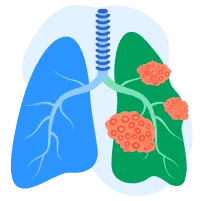












When you have your lung cancer diagnosis, the doctor often tells you which stage of cancer you are in. Most people understand that the higher the stage, the more serious the condition. That is true, but the staging of lung cancer can tell you how much your lung cancer has developed and which parts of the lung are affected. We can explain more in detail.

Why do you need to know the stage of your lung cancer?
Staging in lung cancer will tell you where the tumor is, its size, and how far a cancer has spread. The staging provides a common language for you and your doctor to discuss the progression of cancer without using too many technical terms. It also is an important part in deciding on the best treatment option for you.
What are the stages of lung cancer?
There is a formal staging classification that most doctors use. It is called TNM staging classification. It is dependent on three factors:
- The size and location of the tumor (T or tumor status);
- Whether lymph nodes are involved (N or nodal status);
- Or if the cancer has spread further than the lymph nodes (M or metastatic status).
For example, if there is no tumor, it will be T0. If the cancer has spread to local lymph nodes, it will be N1.
Stage classification for both small cell lung cancer and non-small cell lung cancer are different.
Non-small cell lung cancer
Non-small cell lung cancer is more complex than small cell lung cancer. It follows the formal classification, TNM staging. It is divided into the following stages:
- Stage 1A. Cancer is found in the innermost lining of the lungs and in deeper lung tissue. The tumor is not more than 3 centimeters across and has not invaded the bronchus or the lymph nodes.
- Stage 1B. Cancer has grown larger and deeper into the lung tissue. The tumor has grown through the lung into the pleura, is more than 3 centimeters in diameter, or has grown into the main bronchus. The cancer has not yet invaded the lymph nodes. Surgery and sometimes chemotherapy is used to treat lung cancers in stage 1A/1B.
- Stage 2A. Cancer is less than 3 centimeters in diameter but has spread to the lymph nodes on the same side of the chest as the tumor areas.
- Stage 2B. The lung cancer has not spread to the lymph nodes but has grown into the chest wall, main bronchus, pleura, diaphragm, or heart tissue. This stage can also mean that the cancer has spread to the lymph nodes and one of the following is true: the tumor is more than 3 centimeters in diameter, the tumor has grown into the bronchus, or the tumor has grown into the pleura.
- Stage 3A. In this stage, the tumor is found in the lung and in the lymph nodes in the middle of the chest, also described as locally advanced disease. This stage of cancer can be removed surgically.
- Stage 3B. The tumor can be any size. The lung cancer has invaded the lymph nodes and spread to both lungs, neck and possibly the heart, major blood vessels, or esophagus, thus it cannot be remove by surgery. This stage is treated with chemotherapy and sometimes radiation.
- Stage 4. The lung cancer has spread to other body parts. This stage is the most advanced stage of lung cancer. The patient may be a candidate for a clinical trial, used to evaluate the efficacy and safety of new drugs.
Small cell lung cancer
Small cell lung cancer usually does not follow the formal staging classification. It tends to spread (metastasize) early and is classified into two stages: limited stage or extensive stage.
Limited stage means that the lung cancer is confined to one side of the chest.
Extensive stage means that the lung cancer has spread outside of the chest. Common areas where lung cancer can spread to are the liver, adrenal glands, bones and the brain.
Staging of lung cancer will help your doctor determine which treatment is best for you. Keep in mind that staging does not necessarily indicate the likely course and outcome (prognosis) of your lung cancer. Your prognosis depends on your overall health, strength, other health conditions, and response to treatment.