




























If you are able to pronounce the word ‘Family’, ‘Fun’ or even ‘Violin’, you should perhaps thank our ancestors for making the cultural shift to agriculture and processed food at the turn of the Neolithic era, which led to the emergence of soft food (softer compared to what it was before). The consonants ‘F’ and ‘V’ are known as labiodental consonants (labio=lips, dental=teeth) because in order to pronounce them, contact needs to be made between the upper teeth and the lower lips. The ability to pronounce labiodentals may not be that common today if our ancestors didn’t make that shift towards softer food at the time or at all.

This theory was put forward by American Linguist, Charles Hockett in 1985. Hockett found that the way early hunter-gatherers used their teeth and the configuration of their bite, makes pronouncing labiodentals unnaturally hard, suggesting that such a skill is relatively new and likely to start when humans decided to make soft food as a major part of their diet.
As the argument goes, chewing tough and fibrous food put a lot of stress on the developing lower jaw and wears down the molar. The adaptation to this? The lower jaw becomes bigger and the molar will grow farther and drift more to the front, causing the bite configuration to be in a manner known as edge-to-edge bite. Try this -close your mouth shut and ask yourself, does the tip of your upper and lower central incisors meet? Surely not right? Because most of us have the overbite configuration.
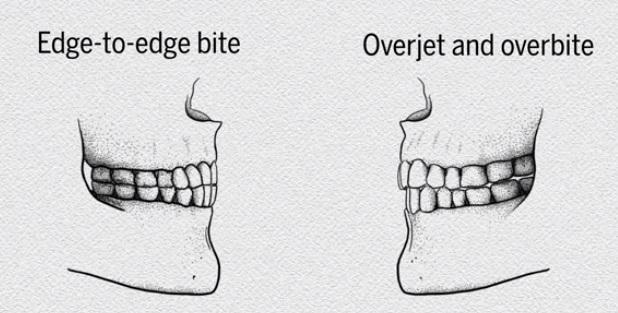
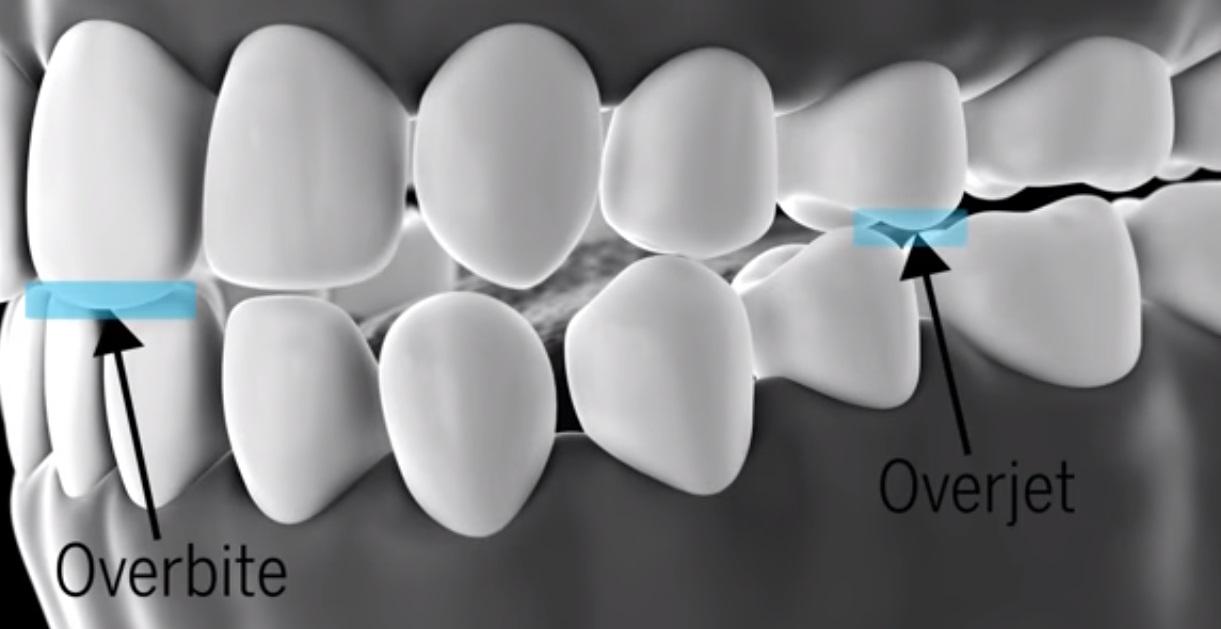
Edge-to-edge bite makes it more difficult for the upper central incisors to touch the lower lip, an important movement to pronounce labiodentals. As our diet evolved into consuming softer foods, the previous strain and stress on the lower jaw is gradually removed and our genetic and biology adapted to this – our jaw got smaller, causing the upper central incisors to be more in front compared to its lower counterpart and closer to the lower lip, producing an overbite and an overjet.
Six researchers from German, Switzerland, Singapore, France, Russia, America and the Netherlands, decided to test Hockett’s theory and published their result on the 15th of March in the Journal Science. The summary of their findings are as follow:
- Biomechanical model simulation of each bite configuration found that the overbite configuration, required 30% less muscular effort compared to the edge-to-edge bite when it comes to pronouncing labiodentals. This ‘facilitation’ helped spur the use of labiodentals by increasing accidental pronunciation in early humans.
- They then reviewed the lineage and root of the language of the world and found that hunter-gatherer’s language (in it’s geographical confinement) used only a quarter of labiodentals compared to those of agriculture-driven early humans who, consumed soft food.
- Lastly, they investigated the link between the language of the world and found that labiodentals spread remarkably fast from its supposedly first inception up to a point that it became common in less than 8000 years from the birth of agriculture and food processing such as grinding grains into flour.
The newly favored consonants, known as labiodentals, helped spur the diversification of languages in Europe and Asia at least 4000 years ago; they led to such changes as the replacement of the Proto-Indo-European patēr to Old English faeder about 1500 years ago. Today, those consonants have spread through other language groups and labiodentals now appear in 76% of Indo-European languages.
How did such consonants spread so fast? A popular theory suggest that labiodentals was an indicator of social class – In ancient India and Rome, labiodentals may have been a mark of status, signaling a diet of soft food and indirectly, wealth. Therefore, being able to use labiodentals serves as a social advantage, further allowing the pervasive spread of the such consonants.
Linguist Nicholas Evans of Australian National University in Canberra finds the study’s “multimethod approach to the problem” convincing. Ian Maddieson, an emeritus linguist at the University of New Mexico in Albuquerque, isn’t sure researchers tallied the labiodentals correctly but agrees that the study shows external factors like diet can alter the sounds of speech.
The findings also suggest our facility with f-words comes at a cost. As we lost our ancestral edge-to-edge bite, “we got new sounds but maybe it wasn’t so great for us,” Moran says. “Our lower jaws are shorter, we have impacted wisdom teeth, more crowding—and cavities.”
Hello Health Group does not provide medical advice, diagnosis and treatment.