
















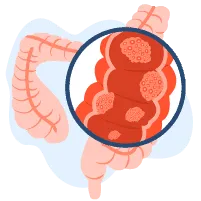













Crohn’s disease is a chronic relapsing inflammatory bowel disease (IBD), one of the two known IBDs with the other one being Ulcerative Colitis. It is characterised by a transmural granulomatous inflammation which can affect any part of the gastrointestinal tract (from mouth to the anus) but most commonly the ileum, colon or both. Although the exact cause remains unknown, it is thought as a result of a complex interaction between genetic predisposition, environmental risk factors and immune dysregulation to intestinal microbiota.

Over the past 50 years, its prevalence has continually increased with the highest incidence being reported in northern Europe, the United Kingdom and North America and the mortality amongst patients with Crohn’s disease has been persistently higher than the general population.
Clinical Features of Crohn’s disease
The diagnosis of Crohn’s disease is a clinical one, formed by the correlation of clinical signs and symptoms, objective data from imaging including endoscopic finding with histologic information as well as laboratory studies. Chronic diarrhoea, defined as a decrease in faecal consistency for more than 4 weeks, is the most common presenting symptoms of Crohn’s disease. Other common symptoms include:
- Abdominal pain (70%)
- Weight loss (60%)
- Blood, mucus or both in stools (40–50%)
Extraintestinal manifestations of the Inflammatory Bowel Disease affects approximately a third of patients with the most commonly observed extraintestinal manifestation being primary peripheral arthritis (33%). Other common extraintestinal manifestation includes:
- Aphthous stomatitis
- Uveitis
- Erythema nodosum
- Ankylosing spondylitis
Because of the transmural inflammatory damage of the bowel in Crohn’s disease, formation of abnormal communications or hollow passages between two organs or cavities (fistulae) can occur and this is the most common complication of Crohn’s disease, occurring in up to 35% of patients. All these clinical features and complications poses serious and significant impact on patient’s quality of life. The impact on patient’s lifestyle can be attributed to taking regular medication, restricting diet and avoiding certain trigger foods, as well as impact on daily activities where patients report absence from employment or school during acute flares due to pain and fatigue.
Risk Factors of Crohn’s disease
Age and gender
Crohn’s disease has a peak age prevalence of between 30 to 39 years old. When it comes to gender influence, there seems to be demographical discrepancies – In the Canadian and New Zealand population, females are 10 to 30% more likely to acquire the disease as compared to males while in Japan and Korea, males are reported to be up to three times more likely to have the condition.
Genetic
2 co-twin cohort studies from Britain and Germany showed that concordant monozygotic twins with Crohn’s disease had similar disease location, disease behaviour and a moderate agreement for age at diagnosis. Familial aggregation has also been demonstrated with most children acquiring the disease at an earlier stage of life compared to their parents.
Ethnicities
In the Jewish populations, high prevalence of Crohn’s disease has been found although the prevalence varies with different geographic locations, suggesting that environmental factors may have an influence as well.
Other inflammatory diseases
Other inflammatory diseases have been implicated with Crohn’s disease such as ankylosing spondylitis, pericarditis, asthma, psoriasis, atopic dermatitis and primary sclerosing cholangitis.
Environment
The rising incidence of the condition worldwide can be attributed to some environmental risk factors, with their impact seen to be most influential during childhood stage. Smoking has been confirmed to influence the phenotype of Crohn’s disease and a meta-analysis found that smoking increased the risk of the disease by more than twice.
A previous history of symptomatic mumps and a high dietary intake of fats, polyunsaturated fatty acids, omega-6 fatty acids and meats have both been associated with an increased risk of Crohn’s disease. Meanwhile, protective factor for the disease includes a high fibre and fruit diet.
Diagnosis & investigations of Crohn’s disease
Currently, no single definitive diagnostic investigation exists to diagnose Crohn’s disease but instead, a comprehensive correlation between clinical manifestations and investigations are needed to form the diagnosis. That said, a full ileocolonoscopy with biopsies is currently the most widely used diagnostic investigation. Other imaging modalities that are used in the diagnostic evaluations of Crohn’s disease includes ultrasonography (US), computed tomography (CT) and magnetic resonance imaging (MRI).
Another imaging technique that is currently gaining traction is the Capsule endoscopy. This method involves ingesting a disposable, small, wireless camera within a capsule which passes through the gastrointestinal tract allowing direct visualization of the mucosa. What’s attractive about this technique is that it is simple and noninvasive. Furthermore, a meta-analysis comparing the diagnostic yield of capsule endoscopy to other imaging modalities found an increased diagnostic rate of 15% over colonoscopy with ileoscopy.
The aforementioned combination of biopsies and ileocolonoscopy is used because a normal finding on ileocolonoscopy alone is not sufficient to exclude the diagnosis of Crohn’s disease, as 27% of patients have disease localized to the terminal ileum which can be very difficult to diagnose. Moreover, the emergence of disease heterogeneity and atypical presentations of IBDs necessitates the need for new diagnostic tools in addition to ileocolonoscopy with biopsy and other imaging studies.
As a result, this push has led to researchers exploring the use of serological markers with the two most intensively studied serological markers being atypical perinuclear anti-neutrophil cytoplasmic antibodies (pANCA) and anti Saccharomyces cerevisiae antibodies (ASCA). The former are antibodies formed against proteins in the nuclear lamina of neutrophils while the latter are antibodies against mannose epitopes from the yeast Saccharomyces cerevisiae. The production of these antibodies occurs most likely as a result of the abnormal response of the mucosal immune system towards the intestinal normal flora in patients who are genetically susceptible. One of the advantage of using serological markers is that it can assist in the differentiation of Crohn’s disease from ulcerative colitis where diagnosis can remains somewhat ambiguous, aside from providing the opportunity for early intervention given their ability to predict development of Crohn’s disease.
Hello Health Group does not provide medical advice, diagnosis and treatment.